Crypto
 Futures
 Success Stories
 The Founder Story
 Testimonials
 Payouts
 Rules
Rules Manifesto


Most trader biographies follow a predictable pattern: early losses, painful lessons, and eventually success. Robert Rother's story, however, defies all imagination…
At 13, he bought his first stock. At 17, he was a partner at a Frankfurt investment firm. At 28, he managed $156 million in China. Then came the shocking collapse: 7 years and 7 months in a Chinese prison.
Today, after more than 30 years of trading experience, Robert is back. As a SPIEGEL bestselling author, certified Bookmap educator, and successful prop trader at IQ Capital, where he received a payout of $17,050 after just one month.
His message is clear: "I recognize when institutional algorithms start buying or selling and then trade the pullback at the VWAP. I follow the smart money instead of betting against it."
 Robert Rother
1995: A 13-Year-Old and a Fascination for the Markets
Robert's trading journey began in 1995, when he was just 13 years old. After the early death of his father, he inherited money and opened his first brokerage account.
"I was always fascinated by the stock markets," he recalls. "So I started researching and trading on my own."
It was a different era — no computers, no internet. Information came from books and television. But two professional traders discovered the talented teenager and offered him something extraordinary: a partnership in their investment firm.
At 17, Robert dropped out of school and became a partner at a Frankfurt investment company. He learned to trade at the Chicago Mercantile Exchange and on American stock exchanges — by phone, from the office in Frankfurt, making calls to Chicago and New York.
"I did that for about 4 years," says Robert. "Then I sold my shares. I had made good money, but I was burned out from trading."
2004: The Rise in China
At 21, Robert left Germany and went to China — the move that would change his life forever.
In 2004, he met a partner in China from the banking industry who was also a lawyer. Together they founded an investment firm in Shenzhen, near Hong Kong. A license, a team, and growing capital fully unleashed Robert's meteoric rise.
The breakthrough came in 2008, during the subprime crisis:
"I made over $800,000 in a single day by moving money between China and abroad. My Chinese partners — the Guanxi network — needed money, and because of the crisis, others wanted to get money out of China. We were the middlemen and took a commission."
After just one year, Robert was leading a team of 30 people at the age of 25, already training his own traders and managing over $156 million. On the side, he ran a Ferrari tuning center — not out of pure passion for cars, but as a networking tool.
"If you have the right network, you get more information. If you know this CEO and that CEO, you can profit from it in the Chinese stock markets."
He also founded Finance China, a website that translated Chinese stock market news into English — the largest of its kind at the time.
The story of this rapid rise of an ordinary boy from ordinary circumstances to one of the most powerful business figures of his time is already fascinating.
But it was about to go even further.
The small side project Finance China would become his real downfall.

"Whoever controls the news, controls the flow of money."
2011: The Fall
"Whoever controls the news, controls the flow of money," Robert explains. "And the Chinese government did not like that."
One month before his arrest, he received a call from the authorities: "Hey Robert, please stop your business. We don't like it."
Robert had purchased all the licenses, fulfilled every legal requirement, built a team of over 30 people. He asked himself: why should I stop?
"But nobody cared about that. In May 2011, they arrested me without mercy for contract fraud, as they called it."
Robert spent 3.5 years in a detention center. Then came the verdict: 8 years in prison plus a fine of 1.2 million RMB.
Another 4.5 years in prison followed. A total of 7 years and 7 months. Under conditions that are almost impossible to imagine.
"In a communist prison, you don't have to think — you just have to follow and obey," Robert describes the time. "9 hours a day working in the factory, 7 days a week. Afterwards there was 'reeducation through labor.' They tell you how great the Communist Party is and how beautiful China is. If you don't obey, you get tortured. I witnessed that many times. You have to act smart to survive."
December 2018: A Stranger in a New World
When Robert was released in December 2018, a new challenge awaited him: he had never held a smartphone in his hands.
"When I came out, I saw for the first time how everyone was walking around with their phones and tablets. A completely new world opened up. Of course we had read about it in newspapers and magazines in prison, but I had never seen it in reality."
The return to normal life was a struggle. Robert moved to a small island in Germany and lived with his mother for two months until he had his own apartment again.
"The most important thing for me was to write the book. It was a kind of therapy."
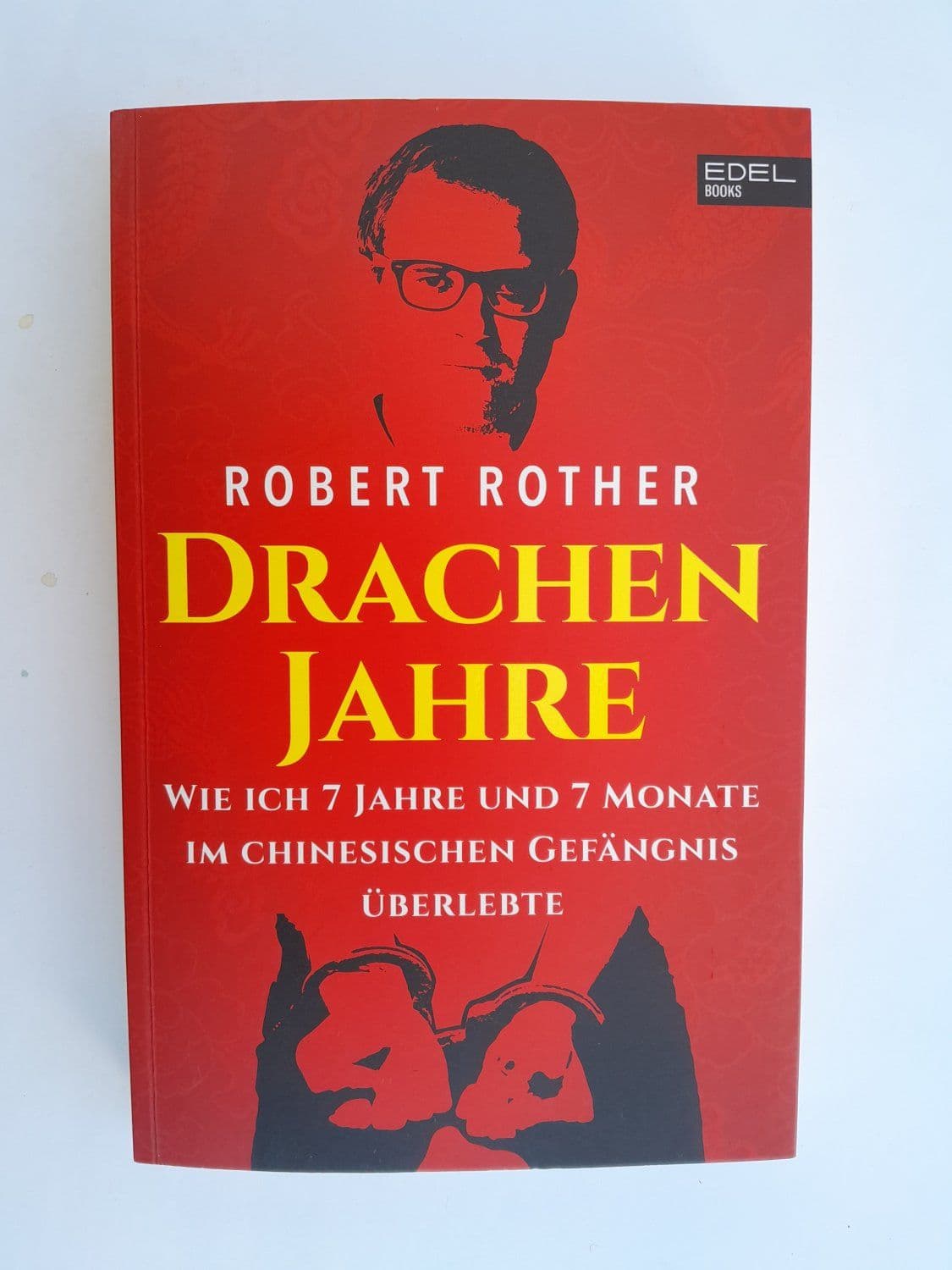
For a year, he worked with a ghostwriter on his story. The result: "Drachenjahre" — a SPIEGEL bestseller that made it into the Top 10.
"I had flashbacks at night when I talked about it. I couldn't sleep. I still have PTSD — sometimes my heart starts racing very fast. There's nothing you can do about it, you just have to deal with it and keep moving forward."
2019: The Rebirth as a Trader
Despite everything Robert had been through, the markets pulled him back.
"When I was in prison, I never had an iPhone, right? I only found out about iPhones after my release in December 2018."
He started researching and in 2019 discovered Bookmap — a software that would change his trading forever.
"I said: 'Oh, this is incredible.' Before, we never had this information. You could only get liquidity levels through other methods — for example, by talking to bankers or having your broker on the phone to find the hotspots in the market."
Bookmap showed Robert something he had previously only been able to sense: when institutional algorithms start buying or selling.
"I was fascinated by this software and from that day on, I started working with Bookmap."
He met Peter Pecker, another Bookmap educator from Germany, and together they built an academy for day trading and stock investing. Today they also have a development team that has built two proprietary tools for Bookmap.
"VWAP is not a magic line indicator — it's the benchmark against which institutional algorithms measure their execution quality."
The "Liquidity Method": How Robert Trades Today
Robert's trading style is built on one simple but powerful insight:
"VWAP is not a magic line indicator — it's the benchmark against which institutional algorithms measure their execution quality."
A Typical Trading Day
Robert lives by Eastern Standard Time (EST) — even though he's based in Germany.
"My day starts later than most. I get up late morning, usually around 11 or 12. Then first things first: coffee and a volatility check (VIX). That's my weather report for the day — if the VIX is below 20, it's going to be a pleasant day; above 20, I become more cautious with my position sizes."
At 3:30 PM German time — 9:30 AM EST — Robert is at his desk without fail.
"Not a second later. That discipline comes straight from prison — there was no flexibility there either."
He trades live with his community on Zoom, explaining his setups in real time and showing how he reads algorithmic activity in Bookmap.
"When I see the algos starting to buy or sell, I wait for the pullback at the VWAP and enter."
His most active periods are the first hour after the US market open and occasionally the final hour at 10 PM German time.
"After that, it's done for the day — sometimes much earlier if the daily target has been reached!"
The Perfect Day
"A perfect day? VIX below 15, a clear trend in the market, and I can see exactly in Bookmap how the algorithms are starting to build their positions. Then I wait for the pullback to the VWAP, enter, and the market moves in my direction. Two or three trades like that across my entire account portfolio, then request a payout and enjoy the rest of the evening."
The Typical Beginner Mistake?
"They see VWAP as an indicator instead of a benchmark. That's the fundamental mistake. VWAP is not a magic line indicator — it's the benchmark against which institutional algorithms measure their execution quality. If you don't understand that, you're trading blind."
Robert is brutally honest about who should avoid his approach:
"Anyone who wants to get rich quickly should stay far away from my style. I sometimes only trade one or two setups per day — some days I don't trade at all because the setup isn't there. If you're someone who needs to be in the market constantly, you'll be unhappy with my approach."

2024: The Discovery of Prop Trading
Surprisingly, Robert only heard about prop trading in 2024 — remarkably late for someone with his experience.
"When I came out of prison in 2018, I didn't know the concept at all. Prop firms in their current form barely existed back then."
Members of his community asked him whether his VWAP strategies would also work for prop firm evaluations.
"I was skeptical — sounds like a scam, I thought. But then I looked at the model closely and realized: this is perfect for people who can trade but don't have capital."
Robert completed his first evaluation at Apex, passed it with his pullback strategy, and received his first payout within a month.
"$35 for an evaluation vs. $50,000 in trading capital — that adds up."
What Makes a Good Prop Firm
After decades in the markets — and 7 years in prison — Robert knows what matters:
"Three things I look at:
First: Do they actually pay out? That's the most important question. A prop firm can have the most beautiful website — if it has problems with payouts, it's worthless. I look at what real traders are saying in forums and on Discord. Not the promotional testimonials.
Second: Are the rules fair and transparent? Some firms have hidden clauses that make it almost impossible to get paid out.
Third: How is the support? If you have a problem, can you actually reach someone? Or do you disappear into a ticket system void?"
For Robert, red flags are: unrealistic promises, no clear rules on trailing drawdown calculation, and firms that have only existed for a few months.
"In this industry, only the solid ones survive — so wait until a firm has proven itself."
Why IQ Capital?
As a partner at IQ Capital, Robert has a clear opinion:
"IQ Capital is interesting because they serve the crypto prop trading market — an area that many traditional prop firms avoid. For traders who feel at home in the crypto space, they offer a legitimate way to trade with external capital."
Was ihm gefällt: „Die Evaluation-Struktur ist klar, und ich habe positive "What I like: the evaluation structure is clear, and I've heard positive feedback from traders who have been paid out there."
His approach works in the crypto market too — his first payout at IQ Capital:
$17,050 in just under one month.
"My approach — recognizing algorithmic activity and trading pullbacks to the VWAP — works in the crypto market too. But the parameters need to be adjusted for the higher volatility. The algos in the crypto space are sometimes less predictable than with ES or NQ futures, so you need a bit more patience and slightly wider stops."
When asked about his stance on Bitcoin, Robert answers pragmatically:
"Neither bull nor bear in the way most people understand it. I'm a Bitcoin realist. Cryptocurrencies are just another market to me — there's price, timestamp, volume, and liquidity. The same four building blocks as everywhere else."
He personally holds some Bitcoin, but not for ideological reasons:
"I hold it because it has an asymmetric risk profile — if it goes to zero, I lose a small amount; if it goes to a million, I'm in."
What he does NOT do: "Leveraged crypto trading as a hobby. The market is too manipulated for that, and the algorithmic activity is harder to read than with regulated futures."
The Most Important Lessons from 30 Years
If Robert could turn back time, he would have two messages for his 13-year-old self:
"Trading is 80% psychology and 20% technique — not the other way around. I spent years searching for the perfect indicator, the holy grail of chart analysis. The truth is: the setup is secondary. How you handle your emotions when the setup goes against you — that's what decides everything."
"Follow the smart money — don't trade against it. If someone had explained to me back then that I needed to learn when the big algorithms become active and simply go along with them instead of trying to be smarter than them, I would have saved myself years of losses."
When someone asks what he does professionally, Robert's answer depends on who's asking:
"If someone is genuinely interested, I say: 'I trade with external capital in the US futures and crypto markets and teach others to do the same. My specialty is recognizing when the big algorithms become active — and then trading in the same direction.'
If I sense that the person thinks trading is just gambling, I simply say: 'I'm a financial educator and SPIEGEL bestselling author.' That saves me the discussion about get-rich-quick schemes.
And honestly — when the question 'Do you do something like Wolf of Wall Street?' comes up, I answer with a smile: 'Nope, I was in a real prison, not a movie.'"
The Message Behind the Story
Robert Rother's life demonstrates something that barely any other trader can claim: he has experienced the highest highs and the deepest lows — and came back regardless.
From $156 million to 7 years in prison — and back to the markets with a clarity that only comes from extreme experiences.
His story teaches:
 Markets change technologically, but the principles remain — price, time, volume, liquidity. That was true 30 years ago, and it's true today.
- Follow the smart money — Robert no longer wastes time trying to be smarter than institutional algorithms. He reads their activity and follows them.
- Patience beats action — One or two setups per day. Sometimes none at all. Those who constantly need to be in the market will fail.
- Prop trading is a real opportunity for competent traders — not because it's easy money, but because the risk-reward ratio is unbeatable for those who can genuinely trade.
Today, Robert shares his 30 years of experience on his YouTube channel, in his community, and as a partner at IQ Capital. His "Liquidity Method" is based on recognizing algorithmic activity — an approach that works in the futures markets just as well as in the volatile crypto space.
For those who dream of getting rich quickly, Robert has a sobering message. For those who are ready to follow the algorithms instead of fighting them, he shows a path proven through 30 years of highs and lows.
Robert Rother is a SPIEGEL bestselling author ("Drachenjahre"), certified Bookmap educator, and partner at IQ Capital. You can find his trading community and free resources at https://www.skool.com/robert-rother
About IQ Capital
IQ Capital is a crypto-native proprietary trading firm founded by professional traders.The company focuses on simplicity, transparency and real market execution.
Traders can start with a low-risk challenge or directly access instant funding, all under one core rule: “We trade fair and expect fairness in return.*
https://iqcapital.io