Crypto
 Futures
 Success Stories
 The Founder Story
 Testimonials
 Payouts
 Rules
Rules Manifesto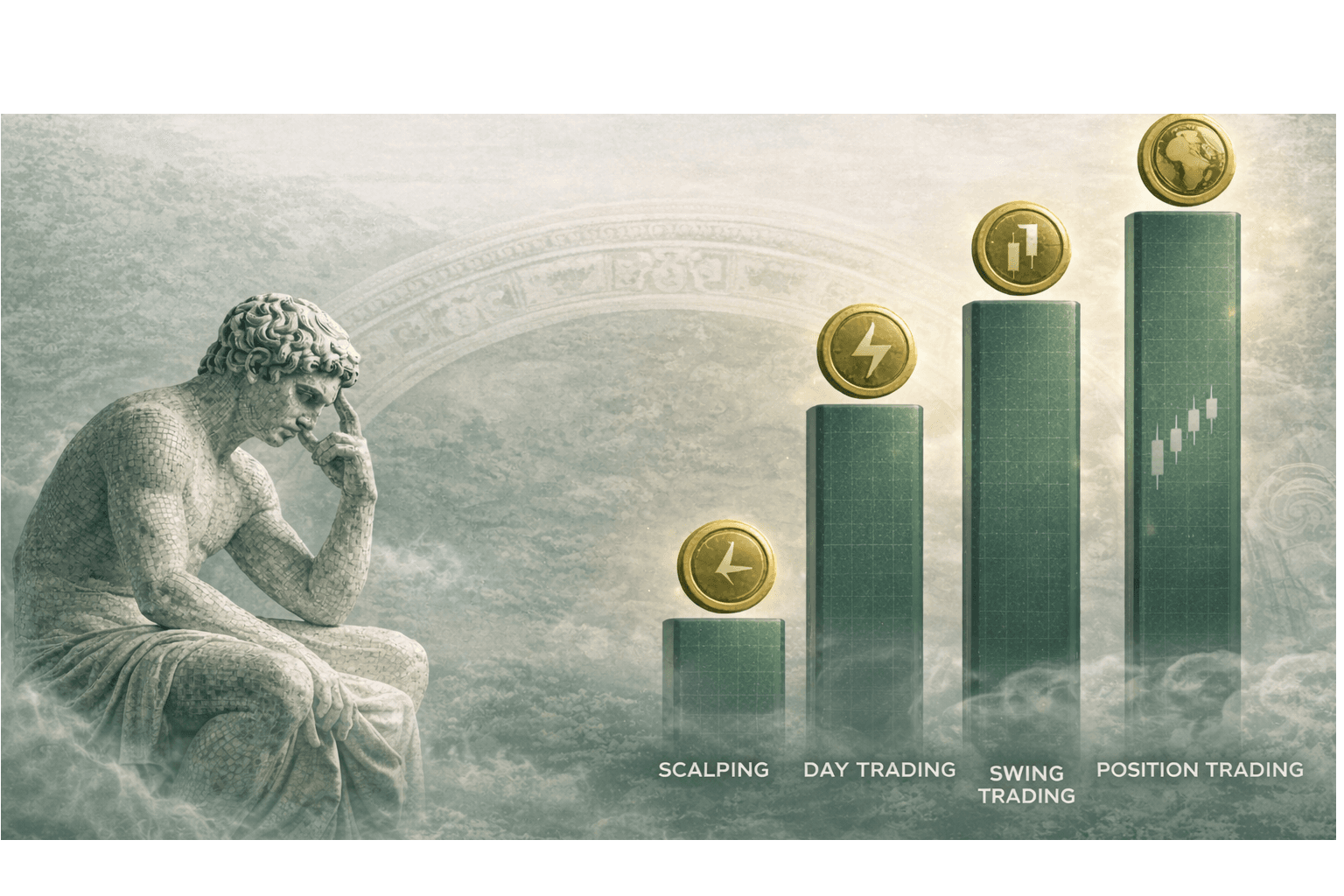



Many traders constantly switch strategies.
Few ever question their trading style.
They do this because they try to trade a system that doesn’t fit their life, their personality, or their tolerance for risk.
But before we talk about indicators and strategies, a different question needs to be answered:

How do you actually operate as a trader?
Trading Style vs. Trading Strategy — a critical difference
Many traders treat style and strategy as if they were the same thing.
They are not.
This confusion is one of the most common and costly mistakes in trading.
A trading strategy answers the question:
What exactly do I trade, and under which conditions?
Entries, exits, indicators, risk rules, setups, etc.
A trading style, on the other hand, answers a much deeper question:
How do I operate in the markets on a daily basis?
Your trading style defines:
how often you trade
how long you hold positions
how much screen time you need
how quickly you must make decisions
how you experience pressure, uncertainty and drawdowns
In other words:
Your style determines the framework in which any strategy must function.
A trader can copy a strategy in minutes.
A trading style cannot be copied, it must fit.
This is why a strategy that works perfectly for one trader can be completely destructive for another.
Not because the strategy is bad, but because the operating rhythm does not match the trader.
For example:
A highly reactive scalping strategy may be profitable on paper, but unbearable for someone who needs time to process decisions.
A swing-trading system may be statistically sound, yet psychologically difficult for a trader who seeks constant feedback and action.
The mistake most traders make is starting at the wrong level.
They look for the best strategy before understanding how they themselves function under risk.
Professionals approach this in reverse:
First, they define their trading style.
Only then do they select or build strategies that fit inside it.
Your trading style is not about being fast or slow, aggressive or conservative.
It is about alignment.
Alignment between:
your personality
your available time
your risk tolerance
and the market conditions you want to engage with
When style and strategy are aligned, trading feels structured and sustainable.
When they are not, even a profitable system eventually breaks down. Usually through emotional errors, overtrading, or inconsistent execution.
Understanding this distinction is the foundation of every long-term trading career.
Only after this question is answered does it make sense to talk about scalping, day trading, swing trading, or position trading.
The Four Core Trading Styles Explained
Once the difference between trading style and strategy is clear, the next step becomes obvious.
There are only a few core ways to operate in the markets. What changes is not the number of styles, but how honestly they are described.
Below are the four primary trading styles explained by our professional traders.
Scalping
Scalping is the fastest and most demanding trading style.
Positions are held for seconds or minutes.Decisions are made under constant time pressure.Mistakes are not educational, they are immediately expensive.
Scalpers trade frequently, often dozens of times per session. This requires intense focus, fast execution, and the ability to stay emotionally neutral while the market moves against you repeatedly.
On paper, scalping looks attractive because losses are small and feedback is immediate. In reality, it is mentally exhausting and unforgiving.
Best suited for: Highly structured, stress-resistant traders who thrive under pressure and can execute without hesitation.
Dangerous for: Emotional traders, impatient personalities, or anyone who needs time to think before acting.
Day Trading
Day trading sits between speed and structure.
All positions are opened and closed within the same trading day. There is no overnight risk, no exposure to unexpected news while markets are closed.
Day traders usually work within a fixed daily routine: defined trading hours, predefined risk limits, and a clear start-and-stop structure.
The challenge is not finding opportunities, but it is knowing when to stop.
Because markets offer constant movement, day traders are exposed to one of the biggest dangers in trading: overtrading.
Best suited for: Traders with stable daily routines who can treat trading like a job, not a casino.
Primary risk: Overtrading driven by boredom, frustration, or the desire to “make something happen.”
Swing Trading
Swing trading slows the pace down, deliberately.
Positions are held for several days or weeks. Decisions are made with distance, not urgency. Screen time is reduced, but patience becomes essential.
Swing traders focus on short- to medium-term market movements and accept that markets do not move every day. This style allows for reflection, planning, and fewer impulsive decisions.
The difficulty is not execution, it is waiting.
Best suited for: Professionals, business owners, or traders who cannot, or do not want to watch charts all day.
Main challenge: Staying patient and disciplined during quiet phases or temporary drawdowns.
Position Trading
Position trading is the longest-term approach.
Trades are held for weeks, months, or even longer.Short-term market noise is largely ignored.The focus is on structure, macro trends, and broader market context.
This style requires less activity but more conviction.Position traders must tolerate drawdowns without reacting emotionally and trust their analysis over extended periods.
For many traders, this is psychologically harder than fast trading — because feedback is slow and uncertainty lasts longer.
Best suited for: Long-term thinkers who value structure, analysis, and patience over action.
Difficult for: Action-driven traders who need constant engagement and frequent confirmation.
Conclusion
Each of these styles can work.
None of them are “better” by default.
The critical factor is not the style itself, but whether it matches who you are, how you think, and how you handle risk.
About IQ Capital
IQ Capital is a crypto-native proprietary trading firm founded by professional traders.The company focuses on simplicity, transparency and real market execution.
Traders can start with a low-risk challenge or directly access instant funding, all under one core rule: “We trade fair and expect fairness in return.*
https://iqcapital.io