
Patrick Nill, two-time Trading World Champion, on the one lesson no course can teach.
Patrick Nill is no ordinary trader. He's a counter-trend trader, two-time trading world champion, and has ranked among the world's top five for five years running. His strategy is frighteningly simple. And that's exactly the secret.
The day the rules stopped applying
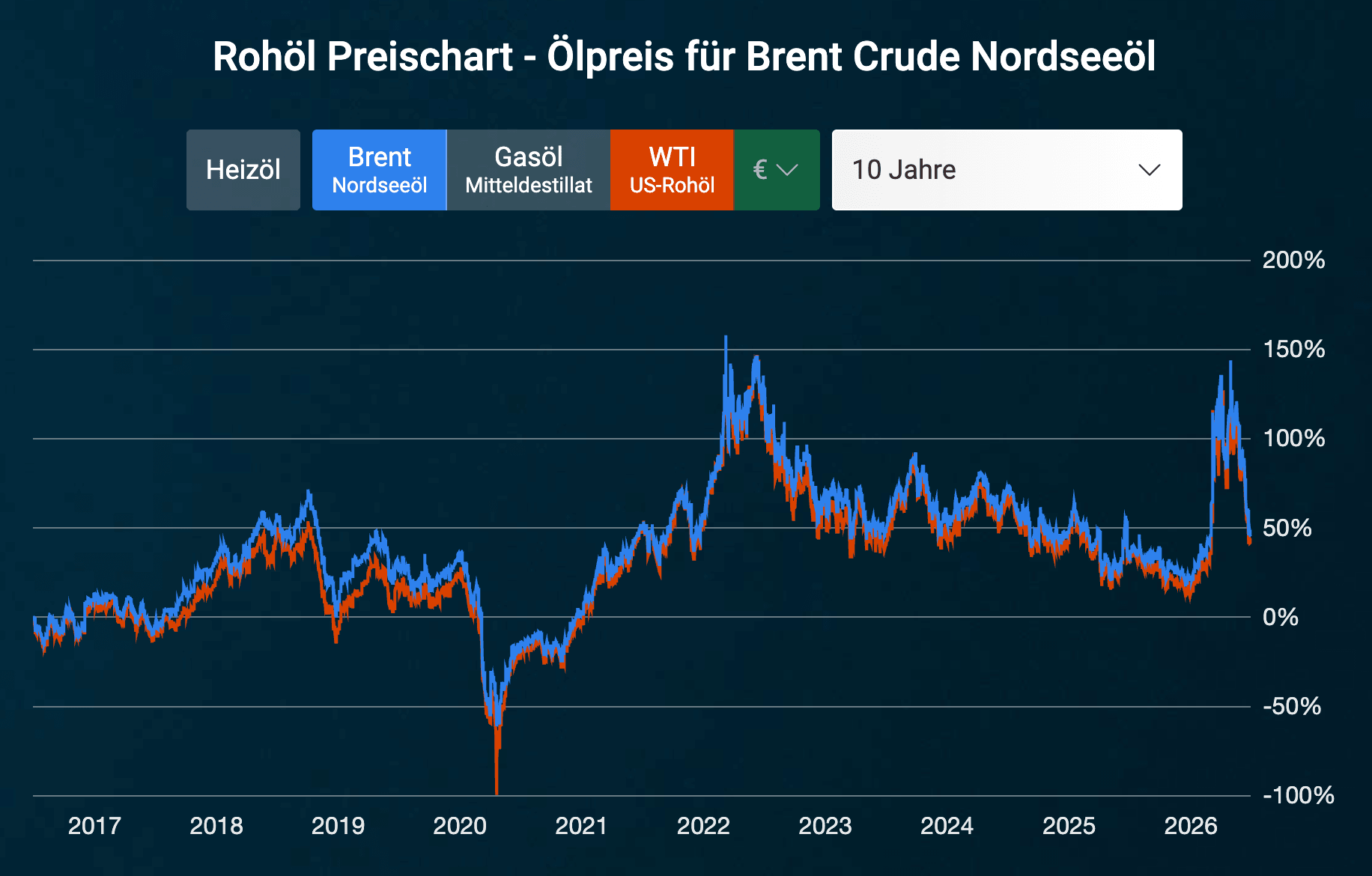
It was spring 2020, when the world started grinding to a halt. The streets emptied, factories shut down, demand for crude oil collapsed within weeks to a level nobody could have imagined. The price fell from 40 dollars to 30, from 30 to 20, to 15, to 13.
Patrick Nill and his team looked at each other and thought the same thing: this has to be the buying opportunity of the decade.
Patrick Nill – 2× Trading World Champion
"Hey, oil is incredibly cheap—we've got to load up. What's the worst that can happen? It drops to seven or eight bucks? That's the absolute worst-case scenario."
nach. Noch mehr. Sie waren überzeugt, dass der Boden nah war. Der absolute Mindestwert, so ihre Logik, lag bei null. Öl kann nicht negativ werden. So etwas gibt es nicht.
Dann, an einem einzigen Tag im April 2020, fiel der Preis für US-Rohöl auf minus 37 Dollar pro Barrel. Produzenten zahlten Abnehmer dafür, dass diese ihnen das Öl abnahmen, weil die Lagertanks voll waren und die Kapazität schlicht nicht ausreichte. Eine Situation, die in der Geschichte der Märkte noch nie vorgekommen war.
Patrick und sein Team schlossen ihre Positionen mit einem massiven Verlust, bevor der Markt vollends implodierte. Es war das brutalste Lehrgeldseminar seiner Karriere. Und der Moment, der ihn für immer veränderte.
Patrick Nill – 2× Trading World Champion
"The market is capable of things you can't even imagine. That's the lesson I learned that day. From that moment on, I never broke my trading rules again."
He buys when everyone else is selling. He waits when everyone else is rushing in.
For years, Patrick Nill has been one of the world's most unconventional traders—not because he relies on exotic algorithms or employs university professors as advisors, but because he consistently does the exact opposite of what most traders believe is the right thing to do.
He is a contrarian trader. While the crowd chases momentum, Patrick waits for the market to become exhausted. While others jump into the move, he positions himself against it. And while most traders try to profit alongside the herd, he profits from its excesses.
Patrick Nill – 2× Trading World Champion
"I'm a true contrarian trader. I always do the opposite of what most people do. It's just how I'm wired."
His system, known as the PVD Models, is built on a simple observation: markets move in impulses and ranges. A strong rally is followed by consolidation. A sharp sell-off is followed by calm. Patrick doesn't trade the impulse itself. He trades what comes afterward—the range, the pullback, the exhaustion.
It may sound like a strategy for masochists. But Patrick didn't develop this approach despite his success—he developed it because of it. He knows when a move has become overstretched, when the market no longer has the energy to continue, when accumulation forms a trading range, and when the real move is still waiting to unfold.
The Astonishing Simplicity of a World Champion
When you watch Patrick analyze a chart, you almost expect the moment when he'll unveil complex formulas or juggle a dozen indicators. That moment never comes.
His charts are remarkably clean: a clear price chart, a Market Profile showing the weekly Value Area Highs and Lows, and occasionally a Footprint Chart when he's trading at his desk. That's essentially it.
Patrick Nill – 2× Trading World Champion
"What I do really isn't complicated. I'm consistent, I do the same thing over and over again, and by the end of the year, the results speak for themselves."
The weekly Market Profile's Value Area High and Value Area Low define the zones where Patrick looks for trading setups. Why these specific areas? Because they're where institutional traders have established their points of equilibrium. Because that's where meaningful trading volume has occurred. And because the market continues to respect these levels—even when fundamental news seems to suggest otherwise.
Patrick demonstrates this live on a DAX chart: a sharp sell-off, triggered by a Trump headline, finds its low precisely at a Value Area High that had been established two weeks earlier. The market respects the technical level, even though no fundamental analyst would have expected the market to find support there.
Patrick Nill – 2× Trading World Champion
"Take a look. This was the Value Area High from two weeks ago. And where did the market stop? Right there. Even though the narrative at the time was dominated by a peace agreement. Technical levels still worked."
The Only Rule That Really Matters
Patrick never risks more than one percent of his trading capital on a single trade. It sounds like a rule everyone knows—and almost no one consistently follows. For Patrick, it's a principle of survival, learned the hardest way imaginable.
The COVID oil crisis wasn't the first time he broke that rule. There were two or three such moments throughout his career. Every single one ended in a loss. The pattern was so consistent that he eventually stopped counting and started treating the rule like a law of nature.
Patrick Nill – 2× Trading World Champion
"No matter what happens, it won't wipe you out. Sometimes I have ten or even twenty losing trades in a row. If you risk only one percent per trade, you survive. You lose—but you're still in the game."
When competing in trading championships, Patrick plays a different game. To even get noticed, you often need returns of 100% or 200%. So he increases his risk to two or three percent per trade, accepts deeper drawdowns, and hopes for the kind of winning streak that propels him to the top of the leaderboard. On his personal account, he would never trade that way.
Understanding the difference between championship trading and real-world trading is essential. The names at the top of the World Championship rankings are not necessarily the traders who are best at protecting their own capital. Patrick is one of the rare exceptions: he wins championships—and he preserves his capital.
First Crawl. Then Trade.
Toward the end of the conversation, Patrick shares a story that has clearly stayed with him. In an interview, Tom Cruise was asked how he became the person he is today. Cruise replied that he first had to learn how to crawl. Then walk. Then jog. Then sprint. And only much later did he jump out of an airplane.
Patrick Nill – 2× Trading World Champion
"I had to start from zero too. The most important thing is never to give up. Just keep taking one step at a time. Trading is no different. People think that after two months and a few YouTube videos, they're fully developed traders. That's simply not true. You have to go through every step, in the right order, and give each one the time it deserves."
Those words come from a man who ranks among the five best traders in the world. There are no promises of overnight wealth, no dreams being sold—just the sober truth from someone who knows how long the journey really is.
Patrick explicitly advises his students not to try to master everything at once. Traders who attempt to learn twenty different strategies at the same time inevitably lose their direction. Success in trading doesn't come from breadth—it comes from depth: from mastering one approach with unwavering consistency, one that genuinely fits your personality.
Patrick Nill – 2× Trading World Champion
"You need to understand your trader DNA. I'm a contrarian trader—that's what suits me. In our office, there are five other traders, and each one does it differently. And they're all profitable. There is no single right way."
What World-Class Trading Really Means
Patrick's story is unusual in many ways: no elaborate backtesting machine, no dozens of indicators, no endless daily analysis of macroeconomic relationships. Instead, there is a clear system, iron discipline in risk management, and the calm conviction that consistency beats brilliance over the long term.
This is exactly the principle behind IQ Capital's platform: no complicated rule structures designed to prevent payouts, but clear frameworks that reward profitable trading. Traders who work consistently should be able to focus on their trading—not on hidden clauses and restrictions.
The prop trading model makes something possible that has long been out of reach for many traders: working with substantial capital without putting their own account at risk. Patrick never risks more than one percent in his personal trading. By trading with external capital, traders can protect this discipline structurally—their own money remains untouched while their trading capacity grows.
For traders who have understood what Patrick learned over decades—that trading is not a sprint, but a series of consistent steps—this is an opportunity, not a shortcut.