
The Man Who Couldn’t Lose: Patrick’s Journey to a Profit Factor of 17
The Nasdaq has been climbing for days as if pulled upward by a tightly stretched string. For weeks, the market had churned within a stubborn, broad range. Then came a brief, deceptive stab lower, followed by a steep rally that hardly anyone dares to stand against.
Patrick is sitting live in front of his community, with a 15-minute chart and a one-minute chart in front of him. He says out loud exactly what he wants to see: a strong downward impulse that breaks the structure. Only then will he go short, right into the midst of the buyers’ euphoria.
A few minutes later, the market delivers exactly that setup. Patrick enters, places his stop above the most recent high, secures his first profits at 1:1, and lets the rest of the position run.
Patrick - IQ Trader
“To the best of my knowledge, I don’t know anyone who trades the way I do. I trade against very strong momentum. But I want that momentum, because if it fails to hold, the reversal will be all the more violent.”
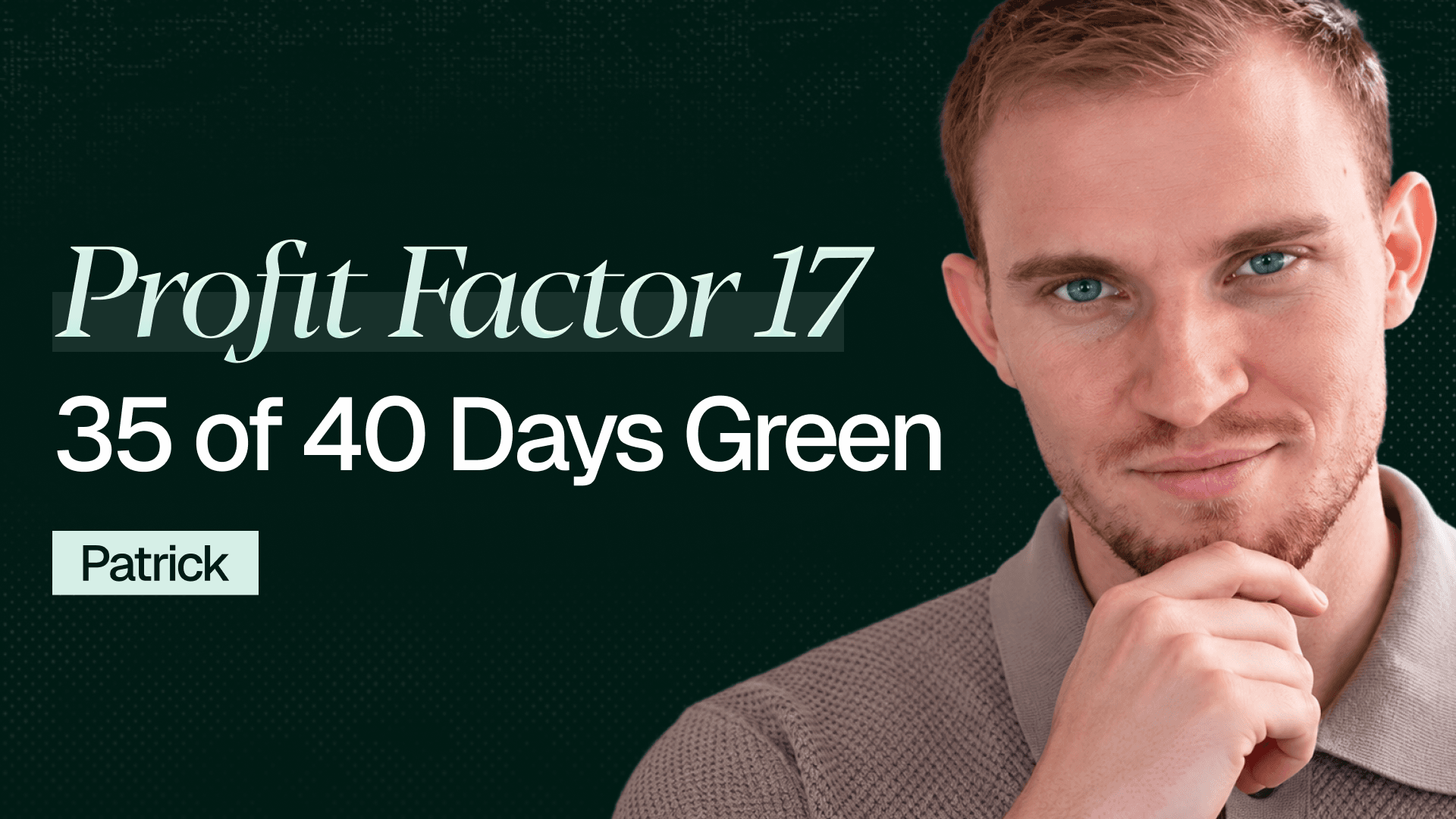
Patrick is 31 years old, comes from the Stuttgart area, is married, and has been a proud father to a daughter for the past year and a half. Under the name The Profit Zone, he trades live on YouTube and Instagram every day. Just a few days ago, he became part of IQ Capital’s Elite Program. And he has just come through a period most traders can only dream of: out of roughly 40 trading days, he closed around 35 in profit, with a profit factor of 17 and more than $25,000 in payouts over the course of two to three months.
But the journey to get there began with a trait that had made him strong throughout his entire life — and that nearly destroyed everything for him in trading.
Losing Was Not an Option
Patrick was a winner from an early age. In soccer, in every sport he took up, he was always one of the best. And whenever he lost, there were tears.
“My parents always said: You can’t lose. Luckily, I couldn’t. Otherwise, I wouldn’t have become as successful as I am.”
At 24, he became self-employed in financial and insurance sales, an industry that isn’t exactly known for handing out praise. A hundred calls for five customers, rejection as part of everyday life. Patrick learned how to deal with setbacks and stay focused. Eight years later, the business is running so smoothly that he only needs to work eight to ten hours a week.
When he got into trading at the beginning of 2024, he brought that winner’s mentality with him. He bought a mentorship from one of the largest German-speaking trading communities, worked his way through the theory, and then wanted just one thing: to get into the market.
“I don’t like all the theory. I want to get started right away and test myself.”
In July 2024, he bought his first funded account. What he didn’t know at the time was that, in trading, being unable to accept losses can be the most dangerous trait you can bring to the table.
Twice Within Reach of the Finish Line
In January 2025, the first payout came. Five days later, he could have withdrawn another $2,000. But on that very same day, he lost the account.
Then came a long, grueling dry spell. For more than half a year, he fought his way back to the verge of another payout. In September 2025, he was there again — and once again, a single trade destroyed everything.
“I was so devastated. I honestly cried. I thought, this can’t be it.”
At that moment, his wife asked him a simple question: Do you really want to do this business? Patrick said yes. Her answer was just as short: Then you’ll make it.
That was all he needed. Patrick sat down at the charts once again, this time with a different question in mind. Not which strategy was the best, but which one suited him.
Between Two Camps
In the mentorship, he had learned volume trading, working with Point of Control, deviations, and specific volume levels. Scalping worked in the short term, but never consistently. He then immersed himself in the world of ICT and came across the Inversion Fair Value Gap. The concept convinced him, but the setups appeared too rarely for his impatient nature.
“In between, I went back to trading a hundred other things. That’s why nothing ever came of it.”
During this period, Patrick was also in regular contact with Matthias Fernholz, whose work he had admired for a long time. Even so, the two hardly ever traded together — deliberately so:
“He has his style, I have mine. You should follow your own and not blindly copy someone else.”
While ICT followers and Order Flow traders mock each other on social media, Patrick positioned himself between the two camps.
His philosophy is as simple as it is uncomfortable: Every strategy works somewhere. It only fails because of the personality of the person trading it — because they get too greedy, too impatient, move their stop too tightly, or close winners too early.
So he took what suited him from both worlds. The result was the Last Fair Value Gap.
The Strategy: The Last Imbalance
The idea behind Patrick’s LFVG is strikingly clear. A strong impulse breaks market structure. Within that move, Fair Value Gaps emerge — imbalances where price moved so quickly that very little trading took place. The key is the last of these gaps before the structure break is completed.
Patrick
“The market doesn’t like imbalances. We move from volume to volume. When we return to the last Fair Value Gap, the imbalance gets filled, and afterward, the new structure can be confirmed.”
Patrick explains why price returns there in terms of the actions of large market participants: During the rapid impulse, many institutional sellers didn’t have the opportunity to fully build their positions. The retracement gives them that opportunity — and that is exactly where he looks to enter.
The rules fit on a napkin. Enter at the LFVG, place the stop above the most recent high — or, more aggressively, just above the gap — take partial profits and move to break-even at 1:1, and let the rest run as a runner. The theoretical target is always the most recent structural low.
One Trading Day Under the Microscope
On this day, the Nasdaq is trading near the upper end of a range that, to Patrick, feels like it has been in place for almost a month. The market had briefly been manipulated to the downside, and at the top, he expects sellers to step in again. The first real accumulation after the long rally is broken by a strong downward impulse. On the first retest, price misses his entry by just three or four ticks, leaving his order unfilled.
Patrick stays calm and waits. The next impulse not only breaks the short-term structure, but also takes out the low that had previously supported the entire long move. For him, that is a double break of structure. When price retraces into the LFVG, he enters short, places his stop above it, and takes his first partial profits at 1:1.
After a correction, another LFVG forms, and the process repeats itself.
He gets additional confirmation from the order flow, read through Deep Charts, whose full version he secured right at launch. His most important tool is the cumulative volume delta. On this day, three strong selling candles confirm the setup, and the delta follows cleanly. Several candles earlier, however, the picture was completely different: there were massive momentum candles there as well, but the delta did not match. To Patrick, that was a sign that buyers had merely stepped aside, only to re-enter passively at lower prices.
For him, a divergence occurs when the delta reaches a new extreme, but price fails to follow. Aggressive market buyers are unable to push price to a new high because passive sellers are absorbing them with limit orders. When such a divergence occurs alongside an LFVG, he calls it a double confirmation.
He mainly uses the Big Trades Bubbles to place his stops and take-profit levels. If a large trade sits just before the 1:1 target, he simply takes partial profits earlier, at 0.7 or 0.8. And when large gaps form during the U.S. session — sometimes measuring 60 to 80 ticks — he fine-tunes his entry using the volume profile. He picked up this trick from Fabio Valentini: within the Fair Value Gap, he looks for the Low Volume Node, the point where virtually no trading took place.
“Very often, price reacts to the tick right there, and you’re not in the red for even a second.”
At the beginning of the stream, Patrick had already called out his target for the downward move: the breakout level of the previous rally. By the end of the interview, price is trading almost exactly there. Anyone who had caught the short near the very top and held it all the way to that level would have ended up with a risk-reward ratio of around 7:1.
One Hundred Dollars, Stop
Once Patrick had found his strategy, something happened that even he could hardly believe.
“I finished one day after another in the green. It just kept going up. I was asking myself every single day: How can this be?”
The secret wasn’t spectacular home-run trades. Often, Patrick would simply take $100 to $150 in profit and call it a day. He traded three accounts simultaneously through copy trading, brought a single account more than $10,000 into profit, and withdrew more than $25,000 in payouts within a very short period of time. Losing days and weaker phases were part of the journey as well, but they were rare.
“From the outside, it looks like someone became successful overnight. But before that, I had blown up a lot of accounts and repeatedly come within reach of a payout. At some point, consistency started to take over, discipline kicked in, and the strategy fit me.”
Three Hundred Dollars, No Matter What
Today, his risk management is almost stoic. He risks a fixed amount per trade, usually around $300, regardless of whether the account is in drawdown or in profit. The stop goes above the most recent high, and he calculates his position size from there. Sometimes it’s 15 lots, sometimes 10 — the risk remains the same.
If you ask him where to start, you get a surprisingly unglamorous answer. Not a strategy, not an indicator, but a question to ask yourself:
“At what loss can I shut down my PC and still sleep peacefully at night?”
Patrick
“First comes the risk, then come the profits. Most people have a decent understanding of what’s happening in the market. But there’s always that one day when you lose control and blow up the account. Most of the time, we have more green days than red ones. But that one day often wipes everything out.”
That is exactly why he sets his daily loss limit and maximum loss per trade before he even opens a chart.
No Backtesting
One of his statements is likely to spark heated discussions in many trading communities.
“Personally, I have zero use for backtesting. If you have a bit of experience, never go into backtesting. The most important factor — your emotions — have no place there.”
Around 90 percent of our decisions are emotional, often made seconds before we consciously press the button. That dynamic cannot be simulated in a backtest. Patrick’s recommendation, therefore: test new strategies live in the market with the smallest possible position size. Small risk, real emotions, honest results.
As for who his strategy is suited to, his answer is equally unexpected. Patient traders benefit because setups don’t appear constantly. But impatient traders can also find their place because they tend to enter each LFVG more decisively instead of hesitating for too long. He says the win rate up to the 1:1 level is extremely high, provided the confirmations are there. What happens afterward — how quickly you take partial profits or move your stop — is then a matter of personal style.
He sums up his mindset like this: First comes the ability to analyze yourself critically. That is followed by constantly working on the emotions behind your trades. Only at the end comes the discipline to execute your own strategy consistently instead of jumping from one system to the next.
Other People’s Capital, A Clearer Head
As a beginner, Patrick assumed he would first have to scrape together €5,000 or €10,000 — or even take out a loan — to trade properly. When he discovered prop trading, the decision was immediate.
“There’s an emotional distance from the subject of money. If you blow an account, it isn’t your own money.”
Today, his own capital works elsewhere, in individual stocks, ETFs, and occasional swing trades. He does his active trading — what he calls his work — exclusively with funded capital.
At the beginning of 2026, Patrick switched to IQ Capital. He now also tests his LFVG strategy on CFDs and higher timeframes, where opportunities with risk-reward ratios of 5:1 to 10:1 are possible. The firm’s rules, with daily loss limits and maximum loss per position, reflect exactly the lesson that cost him so much himself: It’s not the hundred small trades that decide your fate, but the one where you lose control.
A few days ago, Patrick was accepted into IQ Capital’s Elite Program, the next logical step for a trader who has left the trial-and-error phase behind. Officially, he is not yet a full-time trader, even though his trading months are now usually more profitable than his previous business. He feels no pressure.
“I want to become even more confident in controlling my emotions before I say: This is the only way. I’m really looking forward to building a sustainable track record, not just through payouts, but visibly in a real account. I’m genuinely excited.”
The boy who used to cry when he lost a soccer game has learned in trading to accept losses as an integral part of the game. That is precisely what has become his greatest strength.
Patrick trades live every day as The Profit Zone on YouTube and Instagram, where he announces his entries in advance and speaks openly about the psychology behind every trade.