
0.02 Percent Tolerance: Hannes – The Civil Engineer Who Leaves Nothing to Chance in Trading
Structural Statics First, Then the Trade: How a Solid-House Builder from Bavaria Built His Second Pillar:
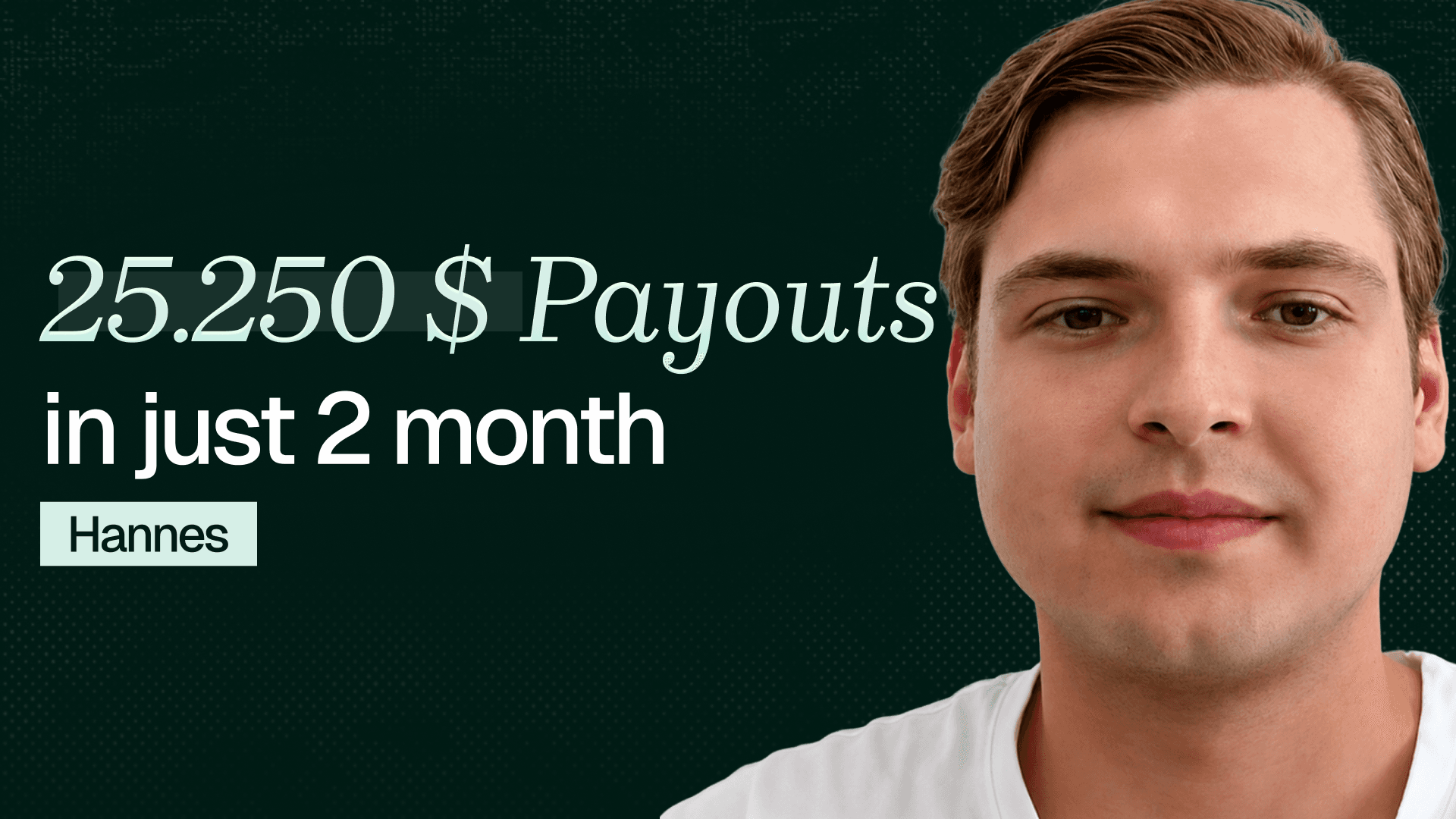
A margin of error of 0.02 percent is what decides, for Hannes, between taking a trade or not. The civil engineer from Bavaria builds turnkey solid houses for families in his region as his main profession, working with exact calculations and no room for improvisation. Since February, he's been applying that same precision to his trading with IQ Capital, with a result that has surprised even him.
"I work hard, I earn well. But how secure is that going forward?"
Probably every self-employed person recognizes this question, even if hardly anyone talks about it openly. The order books are full, the account balance checks out at the end of the month, and yet that quiet unease stays in the back of the mind: what actually happens once the phone stops ringing with new clients, no construction site is waiting anymore, and no paycheck arrives? For employees, the pension system at least shoulders part of that worry. For the self-employed, often only their own discipline is left.
Hannes knows this feeling firsthand. At 26, he runs his own company in Bavaria, building turnkey solid houses for families in his region. A craft he loves, a business that's thriving. And yet he describes retirement planning as one of the toughest issues of his working life. No employer making automatic contributions. No company pension. Just him, having to provide for himself, in an industry where income can swing from one job to the next.
That's exactly where his real story begins — long before anyone was talking about funded accounts or payouts.
Leaving Nothing to Chance: The Systematic Search and the Shift to Futures
Like so many, Hannes started with ETFs. A bit of capital he'd set aside as a young adult was meant to work for him instead of just sitting in a savings account. But he quickly realized it left him cold. The bank sold him funds that nobody really explained, and in the end all that remained was the feeling of having entrusted his money to someone else without understanding what was actually happening.
Through YouTube he discovered the crypto world and got started with Bitcoin and Ethereum. What convinced him there wasn't so much the prospect of quick profits as the honest, understandable way the channels he followed dealt with the subject. Soon after, he tried his hand at his first prop trading challenges and was surprised how quickly it went. Within one to two weeks he had his first funded accounts, and the first payouts started coming in.
But something bothered the engineer in him. The crypto market often felt to him like pure gut instinct, driven by sentiment and news, hardly something you could pin down in clear rules. So he started looking for patterns — recurring situations, structures that could be explained. That search has, since February, led him consistently into the futures market, to the NASDAQ and DAX, where fixed trading hours and recurring market movements offer exactly what he's used to as a civil engineer: predictability.
He still trades Bitcoin and Ethereum today, but no longer as the core of his strategy — rather as a deliberate addition whenever a clear opportunity presents itself.
Structural Statics Is His Foundation
Talk to Hannes about his strategy and you quickly notice: there's no room for interpretation here. Just as he never builds a house without exact structural calculations, he never takes a trade without a fixed percentage.
His futures strategy is an opening range breakout on the 15-minute chart. Half an hour before the market opens, he watches the 15-minute candle and waits to see whether it breaks out above or below with a buffer of exactly 0.02 percent. If it breaks out, he goes long or short depending on the direction, with a risk-reward ratio of 1 to 2 and a stop-loss of 0.2 percent below the entry. He runs this on the NASDAQ and S&P at the US market open, and on the DAX correspondingly early in the morning at the German market open.
Hannes - IQ Trader
"I stick to the rules. I don't deviate just because a week went well or badly."
For Bitcoin and Ethereum, he takes a different, longer-term view. On the daily or four-hour chart, he analyzes the bigger structures, works with the heatmap, and orients himself around support, resistance, and liquidity in the market. He himself jokingly calls this account his "fun account." Here, a modified version of his ORB strategy applies, with a buffer of 0.1 percent on an hourly basis.
Two markets, two time horizons, but one shared principle: before any decision is made, there's a calculation behind it.
The Path Pays Off: The First Payout
Under IQ Capital's challenge rules, Hannes risks one percent per trade, usually one trade per market per day, though up to three depending on how much time he has available. Using a trade copier, he runs several funded accounts in parallel and is currently working on rotating his accounts so that it's not always the same one active, but different accounts on different days.
Over time, he's deliberately adjusted his risk-reward ratio downward. He's come to realize he doesn't need a thousand dollars per trade. 250 to 500 dollars per successful trade is plenty for him. At 0.5 percent risk in the funded accounts, just three winning trades already add up to around 1,500 dollars, and with his usual 1-to-2 ratio, he can comfortably absorb two losing trades without it hurting.
When his first payout came in, it nearly covered what he'd invested himself — a feeling he still describes today as a real breakthrough. Because in that moment, it became clear to him that it isn't about huge capital or hours spent glued to a screen. His system runs in about an hour a day, done by hand, without automation, and still creates real financial breathing room in his everyday life.
Hannes - IQ Trader
"When that first payout came in, I got noticeably calmer. I focused even more on the strategy, only on the funded accounts, nothing else. No more revenge trading, because the payouts came so regularly that a real sense of security set in."











A Clear Head, Even When Things Go Well
Some people would throw a big celebration after their first payouts. For Hannes, success looks different. Instead of a Bugatti or champagne, his ritual is a sheet of paper, on which he documents his trades and his feelings from the past week once a week, usually on the weekend. What went well, what didn't, and above all, how he felt about it. This routine helps him clear his head and avoid getting emotionally attached to individual trades.
The same level-headedness shows when the market goes off the rails. On days with unusual news events or noticeable turmoil in the market, Hannes deliberately sits out. His rule: if a move can no longer be explained by his strategy, it's better not to trade at all than to make an exception.
Hannes - IQ Trader
"Don't deviate from the rules just because something went well for a week. Don't constantly try something new. What works, you stick with."
His actual goal was never a single spectacular payout anyway, but the consistency behind it. He deliberately splits what he earns. Roughly half flows back in a structured way into his own capital, including into his own gold strategy with position sizes between 300 and 7,000 dollars, also ORB-based. The other half goes toward his family and his life away from the charts.
His job as a civil engineer stays untouched in all this. He has no intention of giving it up — he loves his craft too much for that. What has changed through trading is the time he has left, and the calm with which he now looks toward the future.
Hannes - IQ Trader
"In the last two or three months, a real weight has lifted off my shoulders. I realized that it works, and that gives you a certain calm and a sense of purpose. It changes your whole life."
Why Only IQ Capital Holds Up to Such Exacting Analysis
Someone who values precision as much as Hannes does doesn't choose his prop trading partner at random either. His advice to other traders sounds correspondingly sober: network, exchange experiences, and be careful with the many disreputable providers circulating online, especially since trading is still viewed with suspicion in many circles.
With IQ Capital, that scrutiny held up for Hannes. His first challenge was also his first real proof — within three weeks, the first payout came through. Since then, he's described his experience as consistently positive: fast payouts and support that's reachable immediately and explains questions patiently, with no issue ever left unresolved.
For a man who leaves nothing to chance professionally, that's more than just a nice detail. It's the difference between a provider you work with and a partner you can build a second foundation on.
Hannes - IQ Trader
"Anyone who's interested should just try it and not be afraid of it."