
$1.5 Million From an Indicator Most Traders Ignore - How Darius Kehlmann uses the TPO profile to see what the volume profile keeps hidden
The candle comes without warning. A news headline slams into the gold market, price collapses in one single, brutal move, and everywhere nervous fingers are hovering over the sell button.
Darius Kehlmann sits in front of his three monitors and doesn’t move.
“That wasn’t a good moment to get positioned. You would have just been gambling a little.”
He waits for price to come back. He waits for a candle to close cleanly through the zone where sellers had shown all their aggression before, and for real volume to stand behind the move. Only then does he enter, with a deliberately small position that he adds to only once the market proves him right. And even then not in a rush with a market order, but in a controlled way, right at the ask.
This almost eerie calm is the hallmark of a trader whose name many people have never heard. Yet Darius is one of the most exciting up and coming traders in the scene. He has collected more than $1.5 million in verified payouts. He grew a $3,000 account to $109,000 in less than three months.
Ask him what lies behind these numbers, and you hear a sentence hardly any trader would say voluntarily:
Darius - professional trader
“Every loss is 100 percent my fault. I don’t blame the market.”
When Volume Isn’t Enough
Darius didn’t arrive in the markets as a finished order flow trader. Like so many others, he started with the concepts from the ICT world: liquidity sweeps and fair value gaps that look crystal clear on one timeframe and vanish again on the next. Later came the volume profile, which many know as the indicator of big money because it shows where institutions actually traded.
But one stubborn question wouldn’t let him go.
“In the beginning I only used the volume profile and thought: I don’t get it. Why does it sometimes work the way it works?”
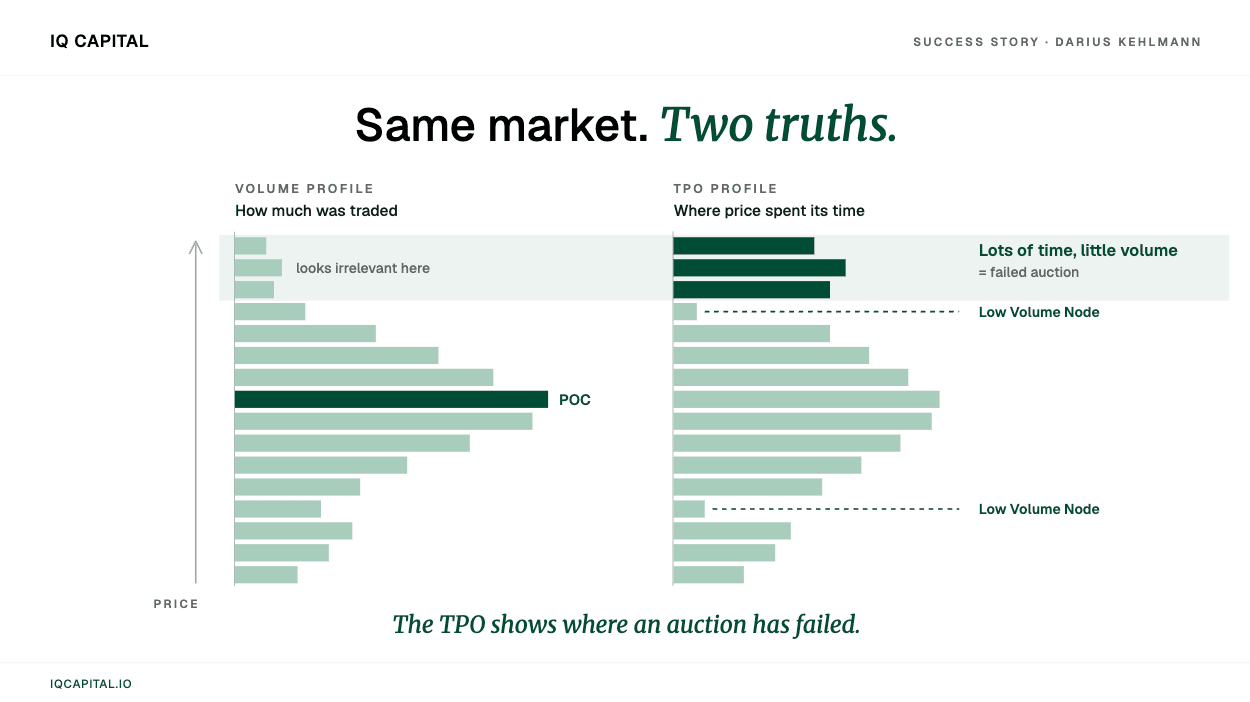
He found the answer in a tool that is older than almost every modern indicator. The TPO profile doesn’t show how much was traded, but where price spent its time. Only when he combined both profiles did the picture suddenly make sense to him.
Darius - professional trader
“Effort versus result. That’s the biggest game changer once you start thinking like that. Instead of treating the result as something magical, you have to understand the intention behind it.”
With the TPO, Darius now spots low volume nodes more precisely than ever before.
These are the thin areas where one side of the market was so aggressive that hardly any trading took place. Where he used to guess between countless small gaps in the volume profile, today he is usually left with two clear zones.
“The TPO shows me the real fair value gaps. I no longer have to mess around with hundreds of timeframes, hoping that this time the hourly chart will show me the gap.”
Standstill in the Market
An unremarkable day on the gold chart shows how much this extra layer changes. Price climbs above an old high, spends quite a while up there and goes nowhere. In the volume profile, this area looks tiny and almost meaningless.
“Most people would say: the volume up there is so small, so it’s not relevant. For me it is relevant, because it shows that they spent time there and failed.”
For Darius, this is a classic failed auction. Whoever pushes in vain up there for that long eventually loses control, and exactly that produced textbook short opportunities on this day.
Three Questions
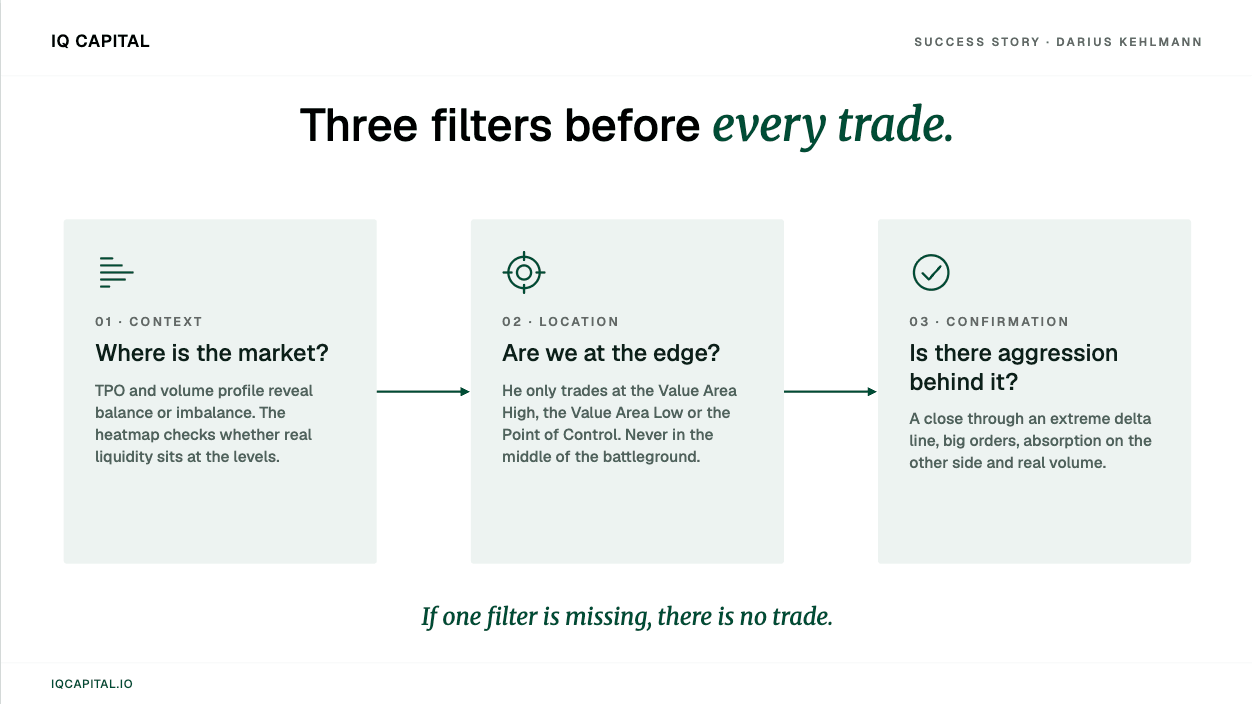
All of his trading follows a simple framework of context, location and confirmation. None of these layers matters more than the others, and he only trades once all of them line up.
With context, he determines whether the market is in balance or whether one side is taking over. Instead of stacking several timeframes on top of each other, he reads both profiles and checks the key levels against the heatmap. A level only interests him if real liquidity is sitting there right now.
“Otherwise we’re just assuming something will happen again simply because it happened once in the past.”
He always plans for both directions. “We’re not guessing here. We’re watching and reacting.”
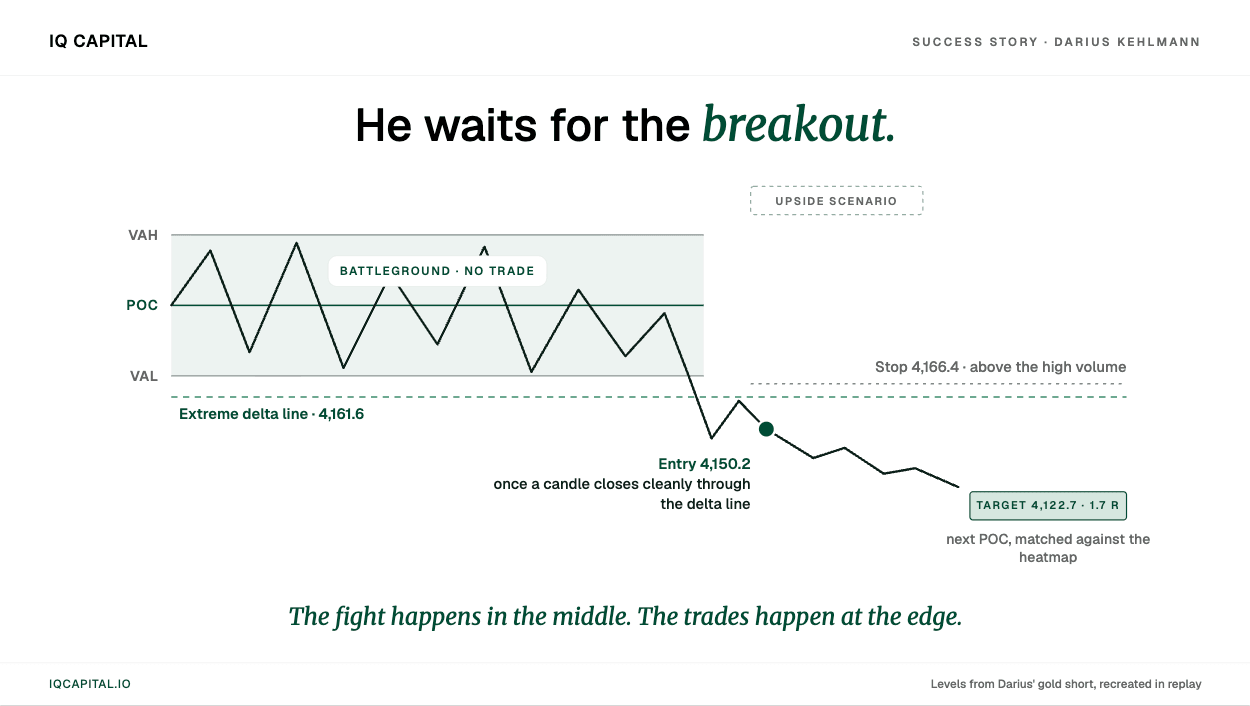
Location decides whether a trade is even an option. In the middle of the value area, where buyers and sellers are locked in a bitter fight, big orders show up everywhere. Many traders see absorption there and jump in. For Darius, that is exactly the most common mistake in order flow. He trades only at the edges: the value area high, the value area low or the point of control.
For confirmation, he looks for extreme delta lines at those edges. When price closes through such a zone, he wants to see big orders being rewarded for their aggression, along with absorption on the other side. Classic volume tells him whether there is serious intent behind the move.
He likes to explain this with an image from the art world: everyone wants the Mona Lisa, so the bids keep rising until nobody is willing to pay the price anymore. Only then does the auction end.
The Art of Doing Nothing at the Right Moment
Gold spends a lot of time in quiet, balanced phases. You could certainly play trades from the edge back to the middle there, and statistically that would often work out. Darius still leaves them alone.
“At some point price breaks out, and then I lose. My trick is to wait for exactly that breakout. That’s my A+ setup, and that’s why I need to bring a lot of patience.”
This patience goes so far that he skips entire trading days. If the next sensible target is only twenty ticks away, he asks himself a sober question: is it really worth risking money for that?
Even on active days, his work begins long before the first click. Before he trades, he goes back over the previous days and deliberately reminds himself why his concepts work the way they do. He wants to get a feel for how the auction is currently unfolding.
Bluffs
One reason order flow is so hard to learn lies in the heatmap itself. The big players who really move the money don’t care about your stop loss. They open massive liquidity pools to draw price in, and pull them away again at the decisive moment.
“It’s a bit like poker. It could be a bluff. You have to learn how to deal with that.”
That’s exactly why Darius considers order flow hard to teach. Order book data can hardly be backtested cleanly after the fact. Anyone who wants to develop this feel has to watch the market live, again and again, until they can tell a bluff from genuine interest.
His Stop
Where others put their stop in the most obvious place, Darius looks at the volume profile of his entry candle. He places the stop above the high volume area, right where a reclaim by the other side would truly destroy the whole idea.
His target is usually 1.5 to 2 times his risk and has to match the liquidity on the heatmap. If the market only offers 1.3 that day, he takes 1.3. If it runs to 2.1, he takes that too. If a level shows up along the way where buyers step in, he secures partial profits and moves his stop to break even.
He advises beginners to use a slightly wider stop, just to become consistent in the first place. And for the moment a trade twitches against you, he has an honest diagnosis ready:
“The market breathes in and breathes out. If you don’t feel comfortable managing the trade, your risk is too high. Or you want to prove something, and that’s when you start to sweat.”
Why a Mistake Is Valuable
In the end, everything leads back to that one uncomfortable sentence. Many traders rely on purely statistical models and already know in the morning that the day might turn into a losing day, because the probabilities say so. Darius doesn’t want to hope on statistics. He wants to understand what the market has to do.
Darius - professional trader
“If I still take a loss, then I made a mistake. This system lets me see whether I’m getting better as a trader or not.”
That sounds harsh, but above all it’s liberating. Anyone who blames every loss on the market has no lever to change anything. Anyone who looks for it in themselves finds a precise lesson in every failed trade. It is exactly this radical honesty that turned Darius from a trader who didn’t understand why his tools only sometimes worked into one who can show seven figure payouts.
An Environment Where No Excuse Counts
Trading like this places high demands on the environment you work in. If every loss is supposed to be your own mistake, there can be no hidden clauses for a result to hide behind. The rules have to be clear before the first trade is placed, so that in the end only one question remains: did I execute my plan cleanly?
This is exactly the kind of trader IQ Capital was built for by professional traders. With transparent rules, real market execution and challenges for both futures and crypto. Whether you read gold through order flow like Darius or are only just finding your own framework, the principle stays the same: we trade fair and expect fairness in return.
Darius built his path with patience, curiosity and the willingness to look himself honestly in the eye. The next story like this could begin exactly the same way.